Blog

  • What Makes a Good Custom Dress Sock: A Materials and Construction Guide

    What Makes a Good Custom Dress Sock: A Materials and Construction Guide

    A custom dress sock lives or dies on details most buyers never think to ask about. The design is the easy part; almost any manufacturer can knit your logo or pattern into a sock. What separates a sock people actually wear from one that sags around the ankle by lunchtime is the construction underneath the design, and once you understand a few numbers you can write a specification that gets you the sock you pictured instead of the one that happened to come off the machine. This is a look under the cuff at what actually matters.

    Needle count is where a dress sock is won or lost

    The most important spec on a custom dress sock is one that rarely appears in the product photos: the needle count of the machine that knits it. Needle count is the number of needles around the cylinder of the knitting machine, and it sets the gauge, or fineness, of the fabric. More needles pack more stitches into each inch, so the fabric comes out smoother and thinner. A casual crew sock is usually knit at around 144 needles, which produces roughly twelve needles per inch and a medium, everyday density. A true dress sock is knit at 200 needles, close to seventeen needles per inch, which is the tightest common gauge and gives that smooth, almost silky surface where you cannot feel the individual stitches. There is also a growing middle option around 168 needles that gets most of the way to a fine dress sock while running faster and cheaper to produce.

    Higher needle count has a consequence worth understanding: the fabric is inherently thinner and lighter. A 200-needle sock typically lands around 130 to 160 grams per square meter, where a chunky athletic sock can be twice that. Thinner is exactly what you want in a dress sock that has to disappear inside a leather shoe, but it means durability leans harder on yarn quality and on how the heel and toe are reinforced. The chart below shows how fabric weight drops as needle count climbs.

    Chart showing dress sock fabric weight in GSM decreasing as knitting needle count rises from 96 to 200 needles
    As needle count rises, the fabric gets finer and lighter, from chunky athletic socks to fine 200-needle dress socks.

    The fibers, and what each one is doing

    No dress sock is made of a single fiber, and the blend is a set of deliberate trade-offs rather than a compromise. The primary fiber sets the character. Long-staple combed cotton is the classic choice, breathable and comfortable with a clean matte-to-subtle-sheen finish; mercerized cotton takes that further with a lustrous, dressier look. Fine merino wool regulates temperature and resists odor, which makes it the quiet favorite for people who wear the same style year round. Bamboo viscose is prized for softness and moisture wicking. All three of these are fine enough in denier to run on a high-needle dress machine.

    What the primary fiber cannot do on its own is survive and stay up, which is where the supporting fibers earn their place. Nylon, or polyamide, is the durability fiber, usually somewhere between a fifth and a quarter of the blend, and it is what keeps a thin dress sock from wearing through at the heel and toe. Elastane, often just two to five percent, is what gives the sock its stretch and recovery so it hugs the calf and springs back instead of bagging. A sock that is nearly all cotton feels lovely for an hour and then slides down; the small percentages of synthetic in the blend are doing the unglamorous work of fit and longevity. The chart below shows representative blends for three common dress-sock builds.

    Stacked bar chart of representative fiber blends for combed cotton, merino wool, and bamboo viscose dress socks
    Representative dress-sock blends: a primary comfort fiber supported by nylon for durability and elastane for stretch.

    Knit-in or embroidered: how your design goes on

    There are two serious ways to put your logo or pattern onto a dress sock, and they are not equivalent. A knit-in, or jacquard, design is made from the yarn itself, formed as the sock is knit so the pattern is part of the fabric with no added layer on top. This is the right method for dress socks: it lies flat, breathes, and cannot peel or crack because there is nothing sitting on the surface. Its constraint is resolution and color count; knit-in designs render blocks of color and clean shapes beautifully but cannot reproduce fine gradients or photographic detail, and every added color raises the cost and complexity. Embroidery is stitched onto a finished sock and suits a small, crisp mark such as a monogram or a compact logo near the cuff, but a large embroidered area adds stiffness and is not comfortable underfoot. As a rule, design the artwork for the knit rather than trying to force a print-style image into yarn, and keep it to a handful of colors.

    The details that outlast the design

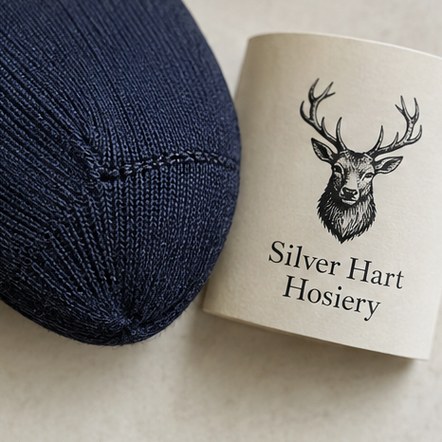
    A few construction choices decide whether the sock still fits after twenty washes. Reinforced heels and toes, usually achieved by knitting extra nylon into those high-abrasion zones, are the first thing to specify on a thin dress sock. A ribbed cuff with adequate elastane is what holds the sock up; a well-made welt keeps its grip without leaving a mark on the leg. The way the toe is closed matters for comfort, and a hand-linked or seamless toe avoids the ridge that a cheap toe seam leaves across the top of the foot. On sizing, blank stock socks are commonly offered in two broad unisex bands, such as roughly US 4 to 8 and 9 to 13, while knit-to-order production can be tuned to more specific size runs, which is worth doing if fit is central to your brand.

    What this means for your custom order

    Put together, these specs turn a vague brief into a real one. Decide the needle count first, because it defines the whole product, and expect a fine 200-needle dress sock to cost more and knit slower than a casual sock. Choose a primary fiber for character and confirm the blend carries enough nylon and elastane to last and hold its shape. Design for a knit-in pattern in a limited palette, and call out reinforced heels and toes and a proper ribbed cuff in writing. Minimums for custom knit socks are often reachable for a small brand, with some manufacturers starting men’s dress-sock runs in the range of fifty pairs per design, and reputable makers will send a physical sample within about a week. Always approve that sample on your own foot, through a wash, before you sign off on the bulk run, because a specification only becomes real once you have felt it.

  • Hello world!

    Welcome to WordPress. This is your first post. Edit or delete it, then start writing!